Choosing the location of a coffee robot is probably the decision that weighs most on its sales. The machine is the same everywhere. What changes is the footfall in front of it, when people pass by and whether they feel like stopping. Before committing a budget, it is better to judge a venue methodically, criterion by criterion, rather than on an impression.
Why the venue matters so much
A coffee robot sells to people passing by. At first, it has neither loyal customers nor a reputation: its revenue depends almost entirely on what happens around it. Two identical machines, one at the end of a quiet corridor, the other on a busy daily route, will give nothing comparable.
That is also why profitability always remains a projection. It rests on an assumption of sales per day, and that assumption comes from the venue. The investment page presents scenarios; it is the location that decides which one you will get close to.
Footfall, but the right kind
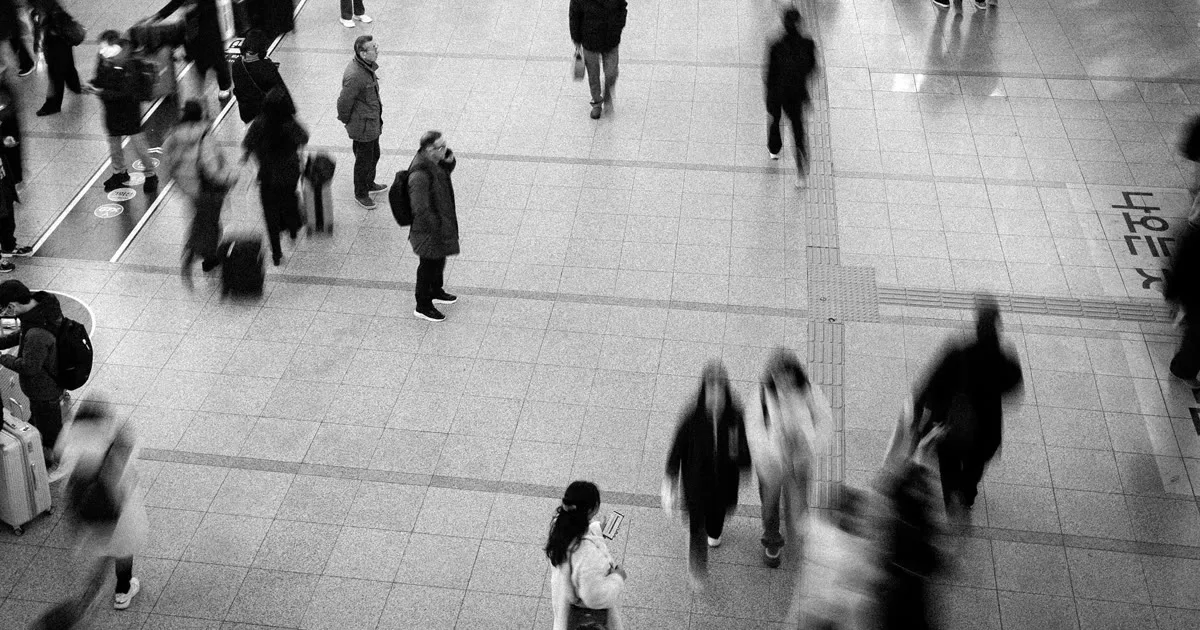
Counting passers-by is not enough. A connecting corridor can see a lot of people go by without anyone stopping. Three questions help refine the picture.
- Do people have time? Someone who is waiting (for a train, an appointment, their turn) buys more readily than someone in a rush. Places where people wait are often more interesting than places they only pass through.
- Do they come back? A daily route (offices, campus, commuter station) builds habits. A place people pass through occasionally depends more on the day's crowds.
- Do they already have coffee close at hand? A café right next door, a free machine in the offices or a bakery at the entrance change a lot. Competition does not rule a venue out, but it must be part of your assumption.
The most reliable method is still to go there. Observe at several times: early in the morning, at noon, mid-afternoon, on weekdays and at the weekend. Note how many people pass, how many already stop somewhere to buy a drink, and how long they stay. These counts are worth more than any general estimate.
The venue's hours and seasons
A coffee robot works with no staff. It can therefore serve early in the morning or late in the evening, provided the venue is open and busy at those times. That is one of its real strengths, but it is useless if the building closes its doors.
- Offices are busy from Monday to Friday and empty at the weekend.
- A shopping centre follows its own opening hours.
- A station or a hospital often has a much wider range of hours.
- A campus follows the academic calendar and can be almost empty in summer.
The season matters too. Hot coffee sells mostly when it is cool; a venue that is very busy in summer may benefit from hosting an ice cream robot as a complement. The article on the ice cream robot as a complement to coffee details this logic.
The main types of venue and what they imply
Each family of venues has its strengths and constraints. None is good or bad in itself: it all depends on the precise spot.
- Stations and transit areas. Footfall is often high and waiting frequent. On the other hand, spots are sought after, terms are set by the venue manager and coffee is often already on offer.
- Offices and companies. Regular customers who come back every day, but concentrated on working days. What to check on site is detailed in the article on the coffee robot in a restaurant or a company.
- Shopping centres and arcades. Good visibility and visitors who stroll, with fixed hours and occupancy terms that are often more formal.
- Campuses, hospitals, waiting rooms. People who have time and often extended hours, but sometimes strong seasonality.
- Restaurants, hotels, leisure venues. The robot becomes an extra offer for customers who are already there, and the question of sharing sales with the venue operator quickly arises.
The terms with the venue owner
Good footfall is not enough if the installation terms weigh too heavily. Before committing, clarify in writing:
- the form of the consideration: fixed rent, a percentage of sales, or a mix of both;
- the length of the agreement and the conditions for leaving it, on your side as on theirs;
- any exclusivity: can the owner install a competing offer next door?
- who insures what, in case of damage or an incident;
- the access conditions for upkeep and restocking.
In a public place or one managed by an organisation, occupying a spot generally requires an authorisation or an agreement with the manager. Allow for the time this takes in your schedule.
A percentage of sales is compared with a fixed rent by applying it to your sales assumption: at low activity, it protects you; at high activity, it costs more. Both can be negotiated.
The technical points to check on site
Some venues that look attractive on paper turn out to be impossible to equip. During your visit, check:
- the available space and whether the machine can be brought in (width of doors, lifts, steps);
- the power supply nearby and its capacity;
- visibility from the main flow: a machine hidden behind a pillar sells less;
- access for upkeep, at times that fit your visits;
- the venue's security outside busy hours.
The robot's precise specifications are presented on the coffee robot page. For a given venue, the simplest is to check these points with us before signing anything.
Testing your assumption before signing
Once the venue has been observed, build three assumptions of sales per day: cautious, average and favourable. For each one, apply the method described in the article on coffee robot profitability: revenue, variable costs, fixed costs, including the consideration paid to the venue.
Then compare the result with the break-even point presented on the investment page. If even the cautious assumption stays well below it, the venue is probably not the right one, however attractive it may be. If the average assumption comfortably exceeds it, you have a serious lead.
In short
A good coffee robot location combines several conditions at once:
- a steady flow of people who have a little time;
- opening hours that let the machine work;
- known competition that has been taken into account;
- written terms, clear and compatible with your sales assumption;
- simple technical access for installation and upkeep.
None of these criteria is enough on its own. It is their combination, checked on site, that turns a venue into a credible location.
If you have a venue in mind and would like to go through it with us, you can contact us.